
Lollipop and Its Aftermath
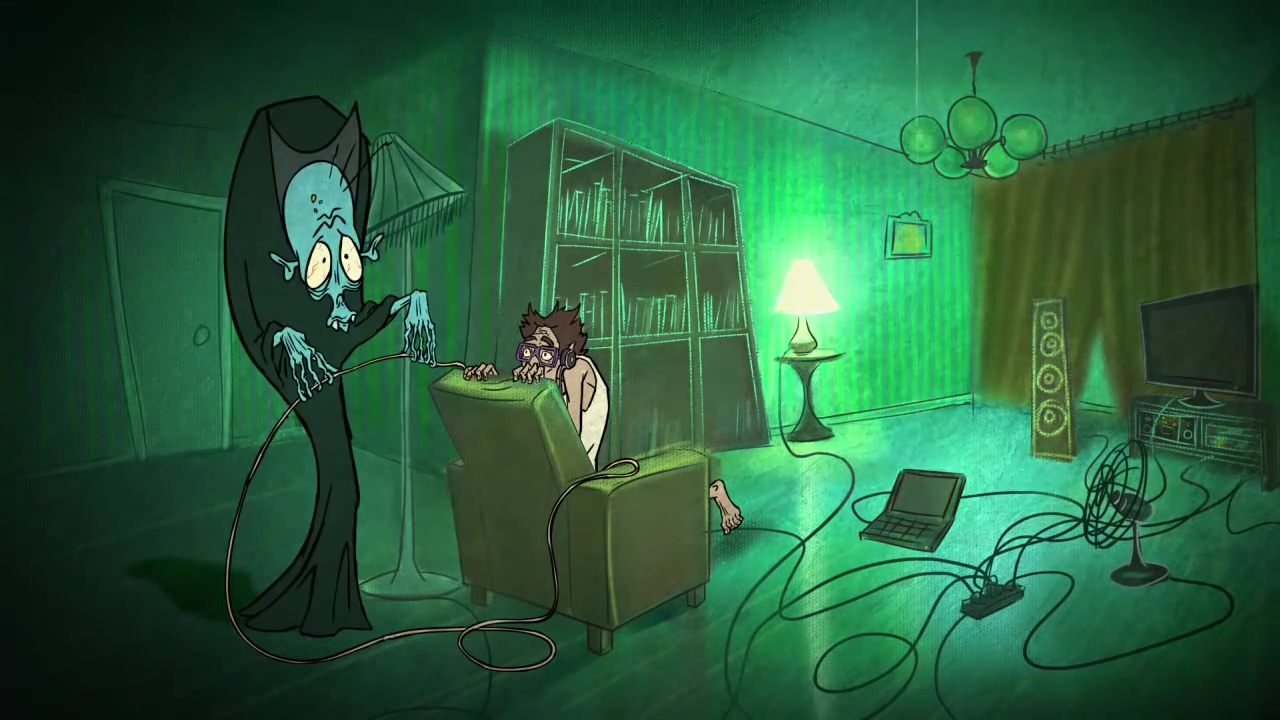
The mystical story of a teenager and his mother, who failed to notice that her son was gradually disappearing because of his addiction to a “lollipop”, stirred up the entire internet nearly four years ago.
The animated short Lollipop, created as part of the social animation series Re-Animation, has won numerous awards at international film festivals around the world and continues to receive positive feedback from audiences. The film’s success and the challenging process of creating his “brainchild” were discussed with us by its director and animator, Genadzi Buto, the creator of Lollipop.
Experience
I had considerable experience working on public service advertising. When I immersed myself in it completely, I became somewhat disillusioned with its methods, because the tasks were far too simplistic. To put it bluntly, it was extremely one-sided propaganda: this is bad, while that, on the contrary, is good. The result felt mechanical and completely devoid of soul.
That is precisely why I decided to follow my own path — and that is how the idea for Lollipop came about. Working in my own way, I envisioned a mother tending to her son’s wound, as if trying to heal it. I saw that one scene so vividly that all the other images and characters grew out of it. Then ordinary logic and intuition took over, and the entire script began to develop.
When everything in art is painfully obvious, that’s not a good thing
The Story
In Lollipop, the mother senses that something is wrong with her child and tries to treat him. But in reality, all her actions are superficial and fail to address the underlying problem — the real problem. Meanwhile, the boy is already going downhill, so to speak: he has tried something and become hooked on something that is destroying him.
And it destroys him in a literal sense: I portrayed this through the gradual disappearance of the main character’s body parts. First his eye disappears, then his arm, then his leg. Eventually, nothing is left of him. Throughout the film, the mother seems not to notice any of this. She keeps trying to fix the visible symptoms, without realising just how serious the problem is.
The Re-Animation Project
The film was created as part of the Re-Animation project, which focused on anti-drug and anti-alcohol messaging. The project was presented as a hard-hitting trash-style series that deliberately rejected ineffective public service advertising methods, including soft or morally instructive approaches. Its main objective was to speak to teenagers in their own language.
Each episode of Re-Animation was made by a different artist, director and animator, and each had its own story, characters and visual style. In fact, I was given complete creative freedom when making my film. That is precisely why I decided to abandon direct, straightforward methods and instead work through sensations and emotions that would reveal the subject in one way or another. In general, when everything in art is painfully obvious, that’s not a good thing.
Reactions
The reactions to Lollipop were very interesting. As for comments on the film online, there seems to be an unwritten rule: if something is good, there’s no point in writing about it, but if it’s bad, you absolutely have to leave an angry comment.
I had already experienced this, but despite that, I received mostly positive comments about the film. I realised that my message had reached people in the way I intended: it had frightened them and made them think.
There were also comments that genuinely made me laugh. Some people suggested that a film like this could only have been made by a drug addict who had been through it all. In fact, I had no such tragic experience. As I said, I simply drew on my creativity, intuition and imagination. Yes, I have had other kinds of dependencies — perhaps they contributed to the story feeling so convincing. It’s no secret that all harmful habits are, at their core, very similar.
Censorship
Some viewers criticised the censors and the creators of the Re-Animation project for allowing such a frightening film to be broadcast. One thing I can say for certain: all the scripts went through an approval process. If my ideas made it through, that means they had been given the green light.
Of course, at first the project managers had doubts about whether the subject would be clear enough. They suggested introducing more direct, conventional clichés. But in the end, they decided not to make any changes to the story — and this did not affect the film’s clarity or accessibility in any way.
Ultimately, Lollipop was watched by around 200,000 people around the world. In addition to being distributed online, the film was released on DVD, screened during themed lessons at schools, and shown at Russian and international festivals.
Festivals and Awards
Lollipop was created in 2009, but it did not appear online until 2010 — a year later. The problem was that the composer had not given me permission to use his music in the film, so I had to look for something else.
Fortunately, I had the opportunity to meet the French composer Bruno Letort, who agreed to create an original soundtrack free of charge. Producing the new music took about a year.
As a result of this considerable delay, the film missed out on many animation festivals: only films created within the previous year were eligible for awards. Nevertheless, I did manage to enter Lollipop in several competitions. Among its most recent awards were the Sound Award at the Moscow independent film festival (formerly the Animatograph Festival) and Best Screenplay at Latvia’s Naked King Social Film Festival.
A New Animated Film
The Re-Animation project has now been relaunched, and I am preparing a new animated film as part of it. This one will also be mystical, and in a sense psychedelic — precisely the kind of thing that resonates with me.
The main character will be older than the previous one, but the film’s potential audience will remain the same: teenagers. It’s difficult to say when my new film will be released — perhaps in six months, perhaps in a year. At the same time, I haven’t ruled out the possibility of further collaboration with the creators of Re-Animation.
The Future of Public Service Advertising
Public service advertising has to evolve. At present, of course, there is a lot of poor-quality media content in our market. Perhaps this is due to a lack of sufficient funding and competitions. If we could change this situation, public service advertising would move to an entirely new level of development.
At the same time, we shouldn’t shy away from Western experience. They produce truly outstanding films and, to some extent, we should learn to make work along the same lines. Cinema, animation and art in general have no boundaries!
Interview: Yegor Shcherbakov
Published on May 12, 2014, in Break Free Magazine