
An Animated Short for Adults. An Interview with Genadzi Buto
The animated short Lollipop was created as one of the episodes of Re-Animation, an anti-drug animated series and a new project by the Guberniya Foundation, based in Moscow. The project has no recurring characters, no overarching storylines, and not even a unified visual style. It consists of short films with striking, often quite harsh graphics and clear anti-drug (and anti-alcohol) messages aimed at teenagers. Some are simply stories with an inevitably tragic ending; others are music videos set to songs by well-known Russian bands and artists, including Purgen, Distemper, Auktyon, Krematoriy, Nebo Zdes, Proverochnaya Lineyka, Doch Monroe i Kennedy, Eclairs, Nike Borzov, Masha Makarova, and others. Among the artists involved are such well-known comic-book creators as Khikhus and Plemyash…
The project was conceived, directed and written by Svetlana Yelchaninova, a graduate of the animation department at VGIK. For the past 15 years, she has also been the director of the famous Jerry Rubin Youth Club in Moscow. In addition to its cheap or even free concerts featuring extreme music, exhibitions and film screenings, the club is known for its highly unconventional approach to working with teenagers. One of its main principles is summed up in the slogan: “Creativity instead of drugs!”

The film’s main characters, a woman and her son, live happily together until strange things begin happening to the boy. He starts disappearing piece by piece but hides this from his mother. Eventually, the terrible truth comes to light, but by then it is too late. The woman begins to suspect that these events are connected to a mysterious lollipop, without which the boy cannot live. The story ends tragically, as do many episodes of the Re-Animation series.
Hi, Genadzi! Tell us a little about yourself so our readers can get to know you. When and where were you born? Where did you study? How did you get interested in animation?
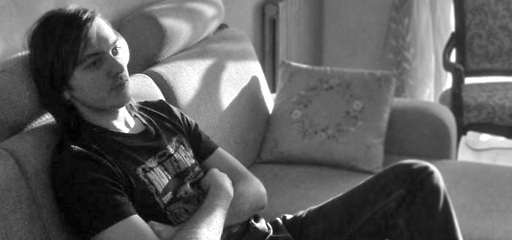
I was born in Minsk. When I was two, my parents were assigned to a job in Grodno, and we moved there. I consider Grodno my hometown.
I finished eleven years of secondary school there, as well as the Children’s Art School. After that, I spent some time wavering between different career options: becoming a surgeon or some kind of artist or designer.
I had been drawing, sculpting and making things since childhood. I was also interested in biology and anatomy, and even collected animal skeletons. Sometimes human ones, too. I used to dream of becoming an archaeologist, digging up dinosaur skeletons, or a mad professor from a horror film.
I started attending an art class at the local House of Culture for Chemical Workers, where it was taught by a very amusing old artist, Garry Konstantinovich Mazurov. I don’t remember how much he actually taught me, but I do remember his impassioned, slightly pompous speeches about art — which was quite understandable at his age. The most interesting thing was that he was completely sincere, and his speeches really were inspiring, even if they were also rather funny.
One day, he kept me behind after class and began explaining some important things to me. I won’t go into all his advice in detail, but the gist of it was that art really was worth devoting your life to, and that the word “artist” actually sounded pretty cool! A bit pompous, yes :). But it turned everything upside down in my head. Suddenly, I had a clear goal in life, something to strive for.
From then on, I was determined to get into the Academy of Arts and began preparing seriously. I studied in the workshop of a wonderful artist from Grodno, and drew portraits of all my relatives, friends and neighbours. For some reason, though, I decided to apply for industrial (three-dimensional) design, even though, to be honest, I was more drawn to graphic art and painting. Perhaps because industrial design seemed modern, fashionable and promising.
I didn’t get in on my first attempt — I failed the final exam in three-dimensional composition. But perhaps that was for the best. To give myself more time to prepare, I enrolled in the Grodno College of Arts to study design. I had a great time there, in every sense, and enjoyed a lively and entertaining year of study. After that, I got into the Academy of Arts on my second attempt, again to study industrial design.
Although by my final years I had clearly realised that the subject I was studying was not for me, the experience was interesting and gave me a lot of useful skills. In my fourth year, I became seriously “addicted” to 3D graphics and animation and spent all my free time learning the software. Working with movement, cameras, lighting, actors and sound — everything just like in real cinema — was completely absorbing. Gradually, animation began to appear on my horizon, even though I had never considered getting into it before. By that time, I was already thinking about making my own animated short. I thought about it constantly. In the end, though, it took me another five years to actually make it.
For my graduation project, I came up with a subject that combined industrial design and video graphics. I decided that it would be my last industrial design project.
The image of the “lollipop” turned out to be quite universal — a kind of concentrated representation of all humanity’s harmful addictions and weaknesses on a stick, not just drugs… How did the screenplay come about? Where did the idea originate?
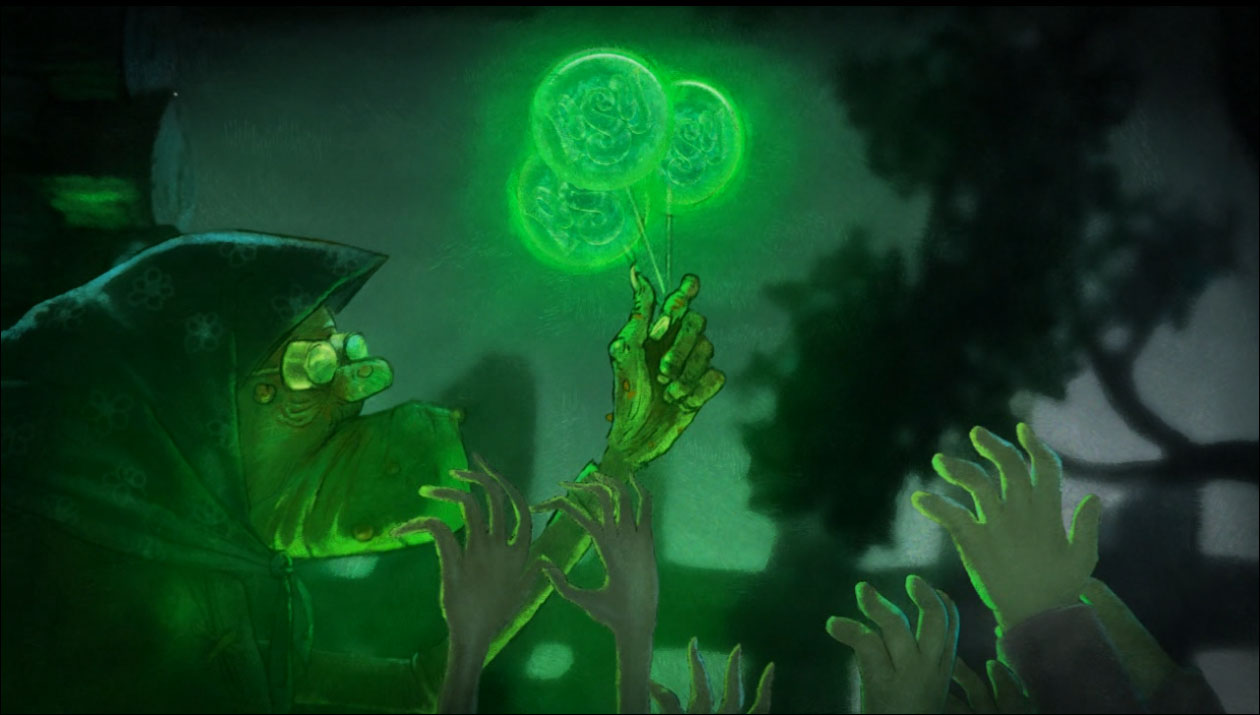
The story came about rather spontaneously, as it always should. I was given exactly one week to come up with and submit a storyline, or several possible storylines, on the given theme. I don’t know how I managed it, but I came up with and wrote two almost complete screenplays for animated shorts. The second one was eventually made into the film.
I was listening to music by my favourite, John Zorn, when a scene suddenly came into my head: a mother applying brilliant green antiseptic to a terrible wound on her beloved little boy’s head. Yet they are both smiling and seem perfectly at ease. Of course, the mother loves her child dearly and is worried about him. But she has accepted the situation and is doing everything a mother can and should do under the circumstances. Everything looks as though it is perfectly normal.
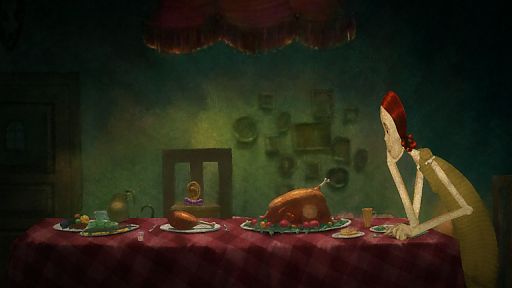
That’s the paradox: something terrible has happened, yet everyone is happy because there is love. I had a very clear feeling for that scene, and everything that followed was simply a development of this idea. Later, I came up with the dinner-table scene with the boy who has turned into an ear. All I had left to do was work out how everything had happened and led to that point. For me, this is the key scene — the quintessence of the film.
You said that the main screenplay was heavily condensed. How many different versions of the screenplay did you write altogether? Was anything important left out of the film?
There were several versions. The main part of the story remained unchanged; it was the endings that varied. The problem was that it was very difficult to tell a complete story and keep it within the two-to-three-minute limit. As you can see, I failed anyway and ended up making a film that runs for six and a half minutes.
There were versions in which we showed what was happening inside the sinister little hut, and the mother eventually sacrificed herself to save the boy.
There was also another, more psychedelic version in which the mother was overweight and had let herself go, while the boy was withdrawn and introverted. At one point, in a fit of resentment born of a sense of injustice, he strangles her beloved little dog and then throws it into a rubbish bin. Then a ghostly aquarium bus arrives, carrying children preserved in jars like pickled cucumbers, and takes her son away. The mother realises that she is losing her son, to whom she has paid too little attention, and tries to stop the bus. But all she manages to do is tear off its bumper, leaving herself lying in the road. A proper children’s horror story.
I found all these themes interesting, but they made the plot swell, and developing them and bringing them to a conclusion would have required much more time, effort, money and so on. So I focused on the central theme — the boy’s disappearance — and only hinted at how it happened. In fact, that part is secondary and only distracts from the main story. I would even have preferred not to reveal where he goes, leaving it a mystery.
The overall look of the film is quite dark. Who decided on its visual style? Where did you draw your inspiration from?
I decided on the visual style myself. I wasn’t consciously taking anything specific as a reference, although, of course, I don’t live in a vacuum, and the film is inevitably a mixture of things I’ve seen at one time or another. Besides, this is hardly a new subject, and it would be impossible to invent something completely original here — nor was that the goal.
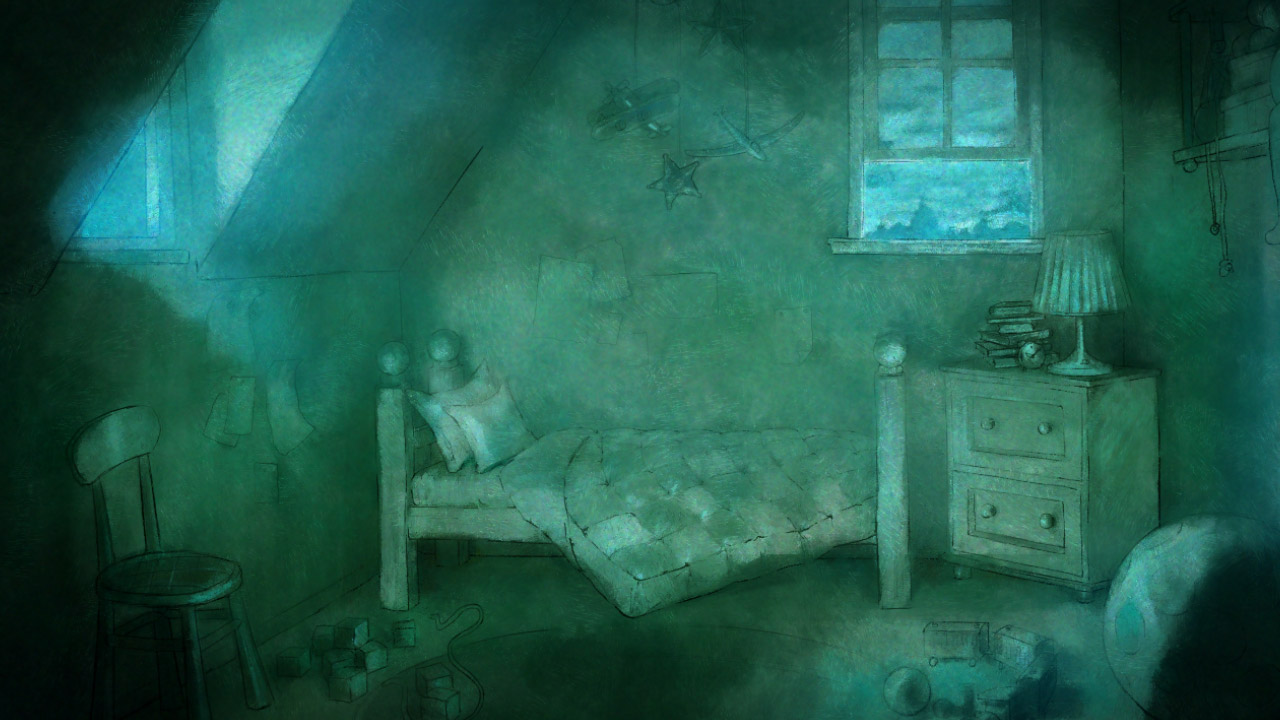
I wanted to put something of my own into this form. I decided to create beautiful, “deep” images that would draw the viewer into their soft atmosphere, making them feel as though they were entering a room. And then I wanted to frighten them a little by introducing sudden, unexpected moments. This contrast in scale — from the charming and pleasant to the shocking — was supposed to have a powerful effect on the viewer. At least, that was what I was aiming for. To establish one set of rules and coordinates, and then suddenly hit the viewer with something completely out of proportion.
Personally, during the final scenes, I got goosebumps, my eyes filled with tears, and I felt a chill in my chest. Especially after adding John Zorn’s music, which, unfortunately, I eventually had to give up.
I drew my inspiration from my dreams. I constantly have nightmares like these, sometimes with entire storylines. I try to write them down whenever I can. At the very least, even if I don’t draw on their actual form, I definitely draw on the feelings they leave behind. After all, feelings are the essence of a dream, not the events that take place in it.
You did all the artwork and animation for the film yourself. How many characters did you draw? How many scenes were there?
I never actually counted the characters. I think there were about fifteen. I worked out the two main characters in detail; the others I drew as I went along, since they only appeared briefly. There were a lot of scenes — around eighty.
How long did it take to make the film, from the initial idea to the final credit? How much time went into creating all the artwork, and how much into the animation?
As is usually the case, I was working on several projects and commissions at the same time, dropping one to work on another, then switching back again. I think the visual part took about four months to complete.
The story, along with all the discussions and approvals, is much harder to put a precise timeframe on, because I sometimes worked on it in the breaks between other jobs. Meanwhile, my brain was quietly sorting things out and putting ideas together on its own, without me even realising it.
What was the most difficult part of making the film?
The difficult part was actually bringing everything I’d imagined to life. When I was writing the screenplay, I didn’t really think about whether I could realistically make it all on my own, whether I could finish on time, stay within the budget or even whether the whole thing was worth doing. I got carried away with the screenplay, and then just plunged straight in, thinking: whatever happens, happens. If you’re going to take a risk, you might as well go all the way.
Working alone is psychologically difficult. Every morning you wake up feeling shaken because it’s the same thing all over again, and the work seems to be going nowhere. You curse everything and sink into an endless, soul-destroying routine. There’s no one to rely on; everything depends on you. There’s no turning back. And I simply refuse to do a half-hearted job. Although, having said that, the film could certainly have been better. I just ran out of time.
Tell us a little about the technology. What did you use?
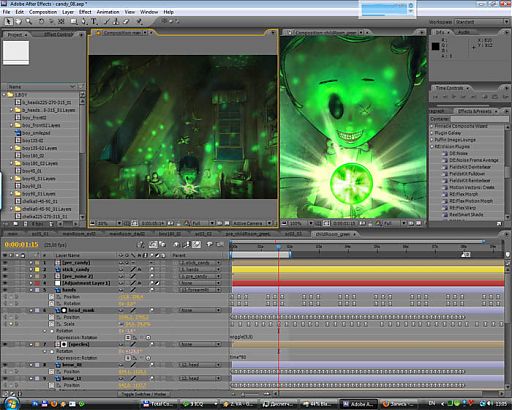
I actually used a fairly standard set of tools. I drew the characters in Illustrator and Photoshop. I traced their outlines in Illustrator, where they came out neater, although the process was very slow and somewhat inconvenient, and then coloured them in Photoshop. The backgrounds were made entirely in Photoshop.
After that, I assembled everything and animated it in After Effects. The characters were animated using cut-out animation, but some parts — the woman’s body, for example — were animated using After Effects’ Puppet Pin tool. I had to connect the pins to one another and to entire objects through a rather elaborate system of null objects and scripts to create something resembling a skeleton. Otherwise, I would have had to animate every point individually, which would have been extremely time-consuming and clumsy. This way, everything followed a hierarchy. In some places, I used a combination of techniques on the characters: pins, deformations and various effects.
Well, that’s about it.
But after really struggling with cut-out animation in After Effects — as I had with the pirate in Belmarket Treasure Map, where I had to pile on all sorts of things until the whole setup became extremely awkward to control and completely back-to-front — I came to the conclusion that this kind of animation is better done in software like Toon Boom, where all the necessary tools are already there and you don’t have to reinvent the wheel. After Effects is completely unsuitable for this kind of work.
Was the music composed specifically for the film? And who is this Bruno LETORT?
Initially, John Zorn’s music was what inspired me to make the film, and I used it to score the original version: http://vimeo.com/8078391. I really liked the result. Later, I managed to get in touch with Zorn himself — practically my idol — show him the film and ask for permission to use his music.
Unfortunately, nothing came of it. First of all, the music was subject to rights shared with the films it had been composed for. Secondly, Zorn himself wasn’t happy with how freely I had cut up his music. However, he was very complimentary about my animation and, as a kind of consolation, sent me something exclusive: a finished musical composition from an album that was still in preparation and had not yet been released.
So I had to hurry up and look for a composer. I received quite a few offers, some of them very good. But the wonderful French composer Bruno Letort beat everyone else, both in terms of timing and the scale of his contribution. He’s an accomplished composer who writes music for full orchestras and has worked with many highly regarded musicians from around the world. What’s more, I later discovered that he had worked on the music for the animated film Coraline. We exchanged emails, and he agreed to compose the music for free. You can imagine how lucky I was :). He wrote something in a slightly different vein, lighter and more ethereal, but retained the overall concept and style.
The credits say the film was made in 2009. When and where was it first screened? Which festivals did it take part in?
Yes, it was made in mid-2009. It was first screened at some of the Re-Animation project’s own screenings.
As for festivals, Lollipop competed in the Debut category at the 15th Open Russian Festival of Animated Film in Suzdal in March 2010, but didn’t win an award. As far as I know, it is still being screened at various Russian festivals without any involvement from me.
At the time, I had to turn down invitations from quite a few festivals because the film still featured John Zorn’s music, which had not been cleared for use. Perhaps I can try submitting it somewhere else now.
Making a short animated film like this requires certain skills, knowledge and a wealth of experience. What had you been doing before?
I worked for several companies involved in producing commercials, graphics and various kinds of design. Eventually, thoroughly disillusioned with that kind of work, I decided to go freelance, which is what I’ve been doing ever since.
I make commercials, music videos and storyboards, and work in graphic design and other fields. It’s a fairly broad range of work. These days, I can clearly see that I’m drawn towards 2D animation, so I’m gradually narrowing down what I do and concentrating on my main direction. At the same time, I’d like to get seriously involved in making video, but as a secondary direction — number two after animation.
I currently take on commercial projects, but all of them are connected, to one degree or another, with animation and the things I love. I hope there will be more of them in the future.
I’m still a newcomer to all of this, and for now I’m simply trying to experiment with different techniques and styles. Practically every project is a first for me. That’s why my portfolio is such a mixture of different things. But that also makes the work incredibly interesting!
What are you planning to do next? Do you have any ideas for new films?
Of course. I’m constantly thinking about my own creative projects, and I already have quite a few of them in the embryonic stages in my head. They are all growing and developing. Some ideas die before they have a chance to mature; others mutate.
To be more specific, I’m currently thinking about another animated short. I also have an idea for a live-action short film. There are several offers to make music videos, too. I won’t reveal anything just yet. Everything in its own time. I hope I’ll be able to bring quite a lot of it to life in the near future.