
Genadzi Buto
Genadzi Buto belongs to a rare breed: the Belarusian animator. He now lives in St Petersburg and works at a major animation studio, but before that he had already created a dozen projects back in Belarus, including music videos for the band Barto and Lollipop, an anti-drug animated horror film. The artist spoke to us from Russia’s northern capital about what it means to live and work as a Belarusian animator.
In our case, it was a little horse that jumped
Buto first realised he was an animator at around the age of eight, when he made his first “cartoon”. He built a simple zoetrope: a rotating drum with slits in it, through which you view a strip of drawings depicting the successive stages of an object’s movement. As the drum spins, the figure appears to move. In his case, it was a little horse jumping.
It would be many years, however, before he made his first proper animated film, Lollipop. In the meantime, Genadzi spent his childhood in Grodno, studied design in Minsk, and then worked for four years as a freelance animator producing advertising.
“Animation is a laborious and time-consuming process, and the pay can vary enormously — it might be $100, or it might be hundreds of thousands of dollars,” says Buto. “But until you’ve made a name for yourself, it’s not easy to work as an animator and make a living from it.”
Genadzi did many of his projects for virtually no money, including music videos. He made three of them for the Russian electroclash band Barto, favourites of Artemy Troitsky. “When they came to Minsk, their manager suggested I make a video for them. Working to an extremely tight deadline, I put together a video about the crisis — a potential hit — in just a couple of weeks.” The video, Soon Everything Will Fucking Blow Up, did indeed become a hit. Its psychedelic imagery of office workers twitching in convulsions turned out to be the perfect prophecy of everything that happened in 2008. “It was quite funny how things worked out,” says Buto. “We made our videos from different locations — I was in Minsk, they were in Moscow — and then, all of a sudden, we all moved to St Petersburg. And what’s more, we now live just a couple of blocks from each other. I sometimes drop by their place.”
“I don’t even have a computer at work”
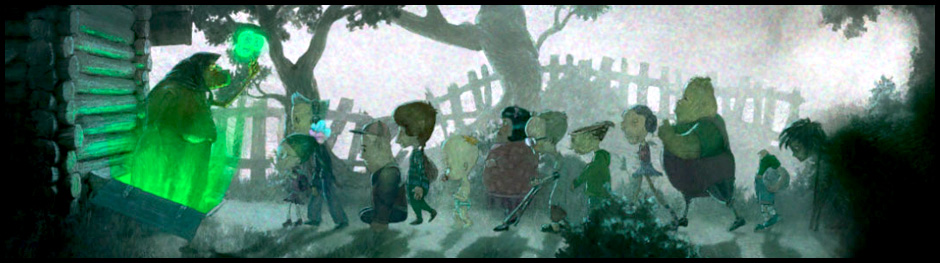
Buto came up with and drew Lollipop entirely on his own. Colleagues and ordinary viewers compared its visual style to the work of Tim Burton and saw allusions to Daniil Kharms in its storyline. The sheer amount of work involved is evident from the fact that even professionals mistake its computer-generated imagery for a digital transfer of a traditionally hand-drawn film. The story takes place in a small town where children disappear in the most horrific circumstances because of a demonic piece of candy. The film was originally made for a Russian project called Reanimation.
“It was a series addressing drug and alcohol abuse, funded by the state film agency,” the filmmaker recalls. “The project ran for four years. My film was the last one, and it was the one that rekindled interest in the project. But things didn’t work out: the TV channel executives weren’t particularly keen on the harsh, dark and pessimistic cartoons.”
In September that year, Buto moved to St Petersburg to pursue his dream of working in traditional animation. His new employer, the Melnitsa studio, had produced one of the biggest animated hits of recent years: a saga about the Three Bogatyrs. Genadz is now working on the next instalment, The Three Bogatyrs on Distant Shores, due for release the following December.
“Two years is a very respectable amount of time for a feature-length animated film — and not that long, either,” he says. “On this project, I draw the basic poses for each scene and all the characters’ actions, determining how each character moves. The directors work ahead of me, while the in-between animators come after me, drawing the intermediate frames between the characters’ key poses.”
Another dream has also come true: getting rid of the computer that had become an absolute pain. “I draw exclusively on paper. I don’t even have a computer at work. I’ve got a little light box with a glass surface and a lamp underneath — it’s called a light table — along with tracing paper and a pencil. That’s all.”
“There should be only one author”
Recently, Buto worked with media artist Alexei Terekhov, who suggested making a video for the band Kerry. The video is due to appear soon. “I don’t like collective creative work, so I told him that either I would do it on my own or I wouldn’t take part at all — even if the offer came from Terekhov,” Buto explains. “I’ve simply had some unpleasant experiences with collaborations. For me, genuine art is an extremely delicate and personal process that leaves no room for compromise. There should be only one author, and every work should be a pure expression of that author’s unique personality.”
In the end, Terekhov came up with the concept and filmed the musicians, while Buto took care of all the animation and directing.
Genadzi is now developing an idea for his next animated film, which he plans to make using either drawn animation or cut-out animation — a technique employed by one of his favourite filmmakers, Yuri Norstein. Soviet animators are his greatest source of inspiration, and he regards the period from the 1960s to the 1980s as “the golden age of Soviet animation — one masterpiece after another.”.
Buto describes his current stage of development as “learning on the job”. He has little time for personal projects, as almost all of it is taken up by his main job. But when your work is also your greatest hobby and your life’s ambition, it’s still a pleasure.

Interview: Polevik
Published: 17.01.2012, on 34mag.net